Red Longo Sets the Stage
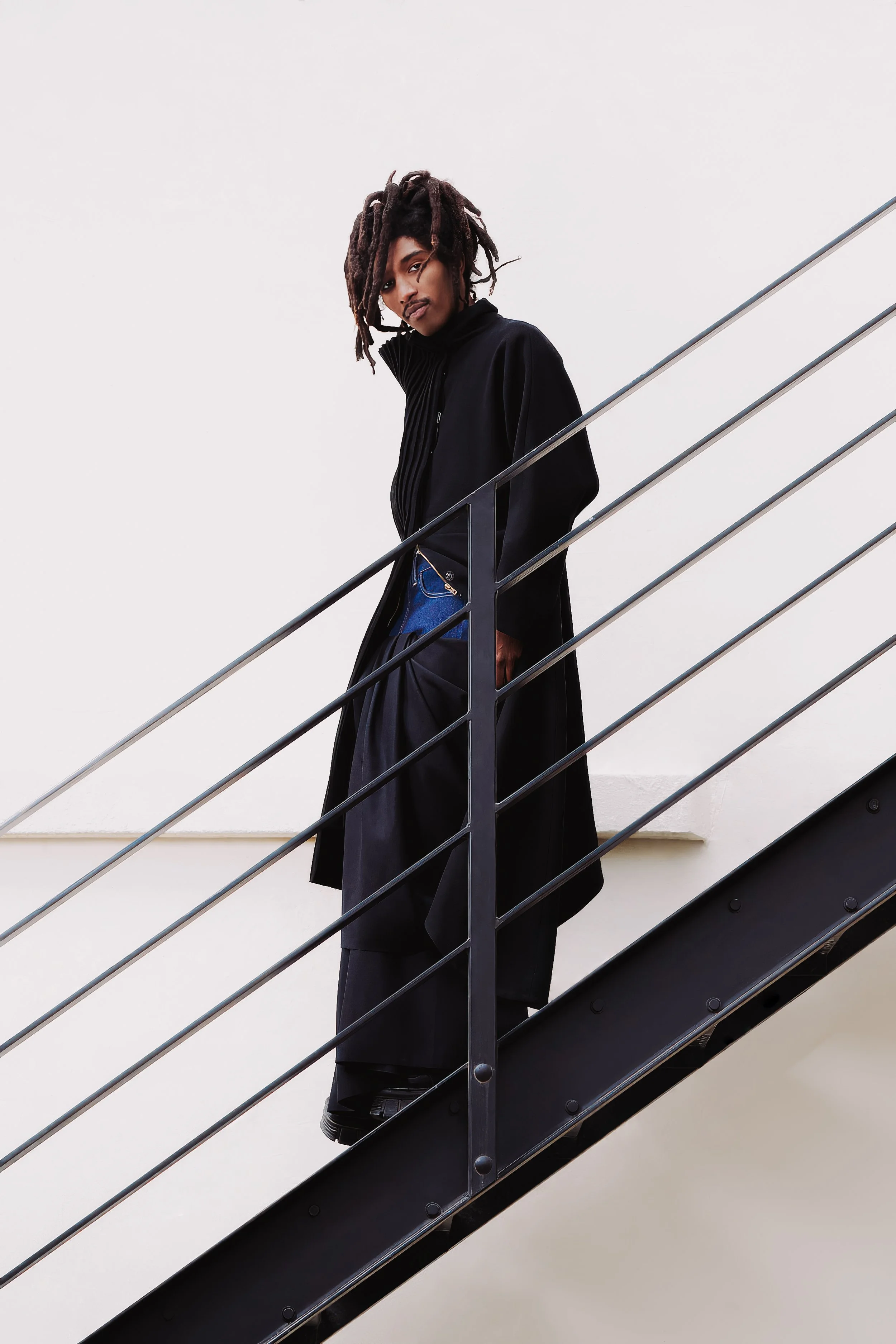
Total Look: Mossi
Photography: Erwan Desmazon
Styling: Eddy Soilihi
Grooming: Eva Cisse
Production: Tom Guez
Assistant Photographer: Elliot SB
PA: Celia Salita
Video: Florian Rey
Red Longo is a visual artist. That’s the easiest label, the simplification, but Red Longo isn’t someone who should be simplified. Born in Ethiopia and adopted in Italy, Red Longo is a graffiti artist, muralist, and storyteller. Before editorial campaigns for Gucci, and collaborations with Diesel, Longo’s passions blossomed from within the folded pages of a video game manual.
At the age of 12, he’d traded all his Pokémon cards for “Getting Up”, a cult graffiti video game about a street artist who exposes corruption through spray paint. Back home, he realized he didn’t even own a console. No TV. No PlayStation. Just the game and its paper manual. So he read it. Obsessively. Over and over, until the story felt like his own and he realized this wasn’t just a game, but a movement. One thought stuck: If I can’t play this game, I’ll live it.
That moment sparked everything. He began painting Milan walls, tunnels, rooftops connecting with other writers, spreading his name across the city. And then came the crackdown. In the lead-up to an expo, Milan launched a full-scale graffiti purge. A vandal squad. Police raids. One morning, they showed up at his house. The tension at home snapped.
So he left and came to Paris.
There, everything shifted. He stopped tagging just for recognition, and started creating a visual language, something people could feel. He sketched a wide-eyed face, caught between joy and fear, and began pasting it around the city. Not just a name. A message.
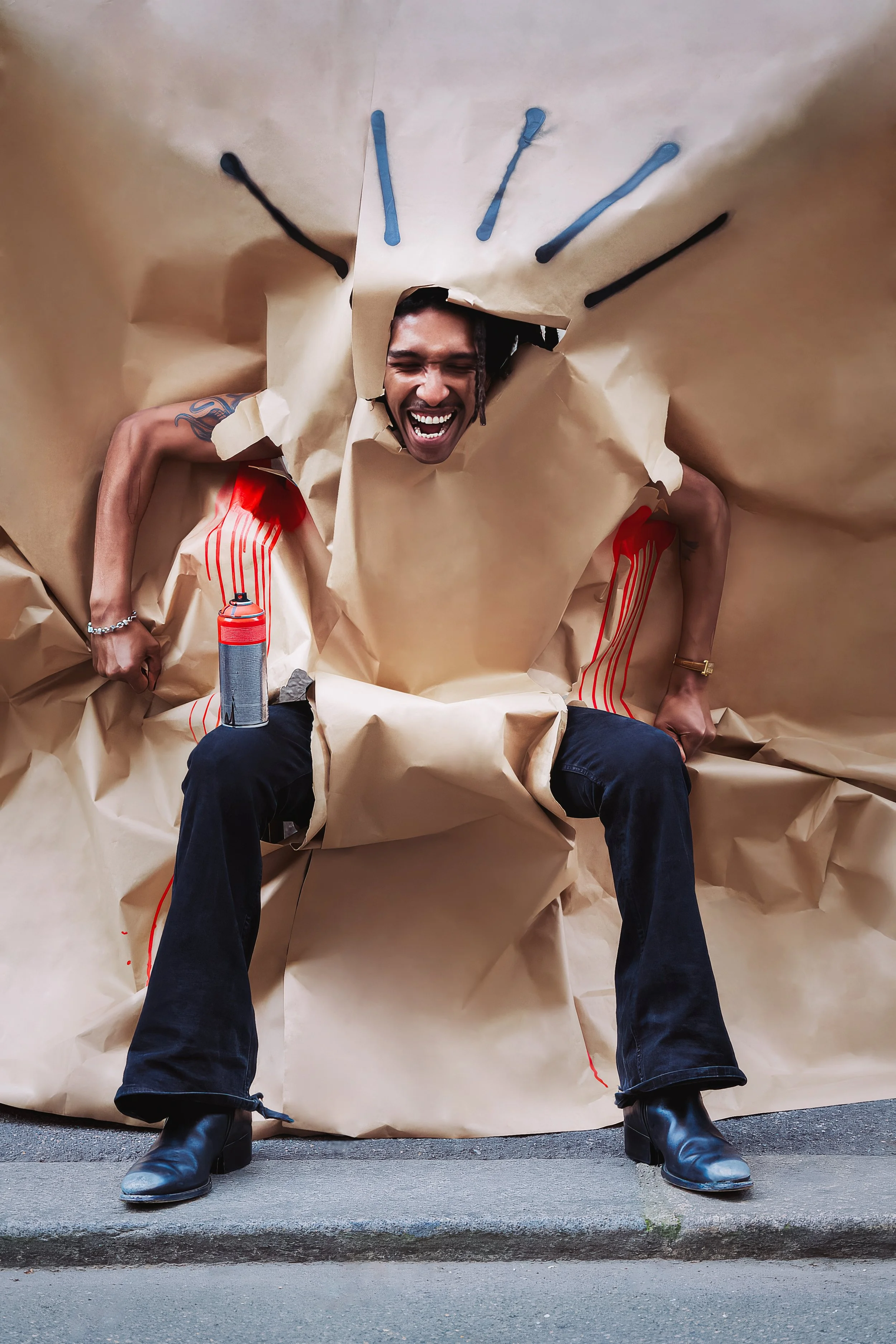
He didn’t plan to get into fashion. He just arrived to a shoot wearing a jacket he’d painted himself. No stylist, no pitch, just what he was already wearing. “They told me, stay. They said, ‘We want to shoot that too.’” From there, things moved fast. More shoots, then people started asking to collaborate. Not because he fit a look but because he brought his own. “I was going to fashion week, but not for fashion,” he said. “I had my coat, my stuff. That’s what they liked.” He wasn’t trying to impress anyone. He just wore what he’d already made. And people felt it. But the intention stayed the same: to communicate. Clothing became a new surface, a new way for his message to enter the spotlight, something people could carry, see, and respond to without needing to find a wall.
Red once told me this as we sat down to talk, the way he tells most stories, loosely, vividly, like he’s remembering and creating at the same time. My first question was about his name, Red, why Red? He said, it’s not about the color. It’s not branding. It’s not even his favorite. It’s about his roots. He was born in Africa and Red is for his birth name, for the dry earth of his homeland, for the spirit he carries with him wherever he paints. “It’s not just a color,” he said, almost like a reminder to himself. “It’s the ground. It’s home”.
When he began painting clothes and changed his name to Red, he did something most graffiti artists don’t. He stepped out of the shadows. He made himself fully visible. He put his face to his work. His presence, once hidden behind rooftops and rail lines, now lives in open spaces and full view. That visibility, that decision to be seen, is its own kind of rebellion.
Red Longo doesn’t separate his art from his clothes or the street from the studio. Whether it’s a wall in the 10th arrondissement or a painted jacket caught in the light, it’s all part of the same performance. It is a stage not to entertain, but to declare. To turn heads, to spark thought, to break the 4th wall. And to exist, fully and openly, in the spotlight.
For our cover story, Red Longo took over a theatre in Paris; shot by Erwan Desmazon, he showed us who he really is and what being an artist actually means.
—--
MERDE: You grew up moving around, always watching, always adapting. Do you remember the first time you used art as a way to say something you couldn’t say out loud?
RED LONGO: Yes, inside me there was a rage I couldn’t explain. As a child in Africa, I experienced traumas I didn’t even have words for. When I arrived in Italy, adopted, I hoped for a new start. But soon I realized racism was everywhere, subtle or overt, and by the age of eight I felt like a foreigner everywhere I went.
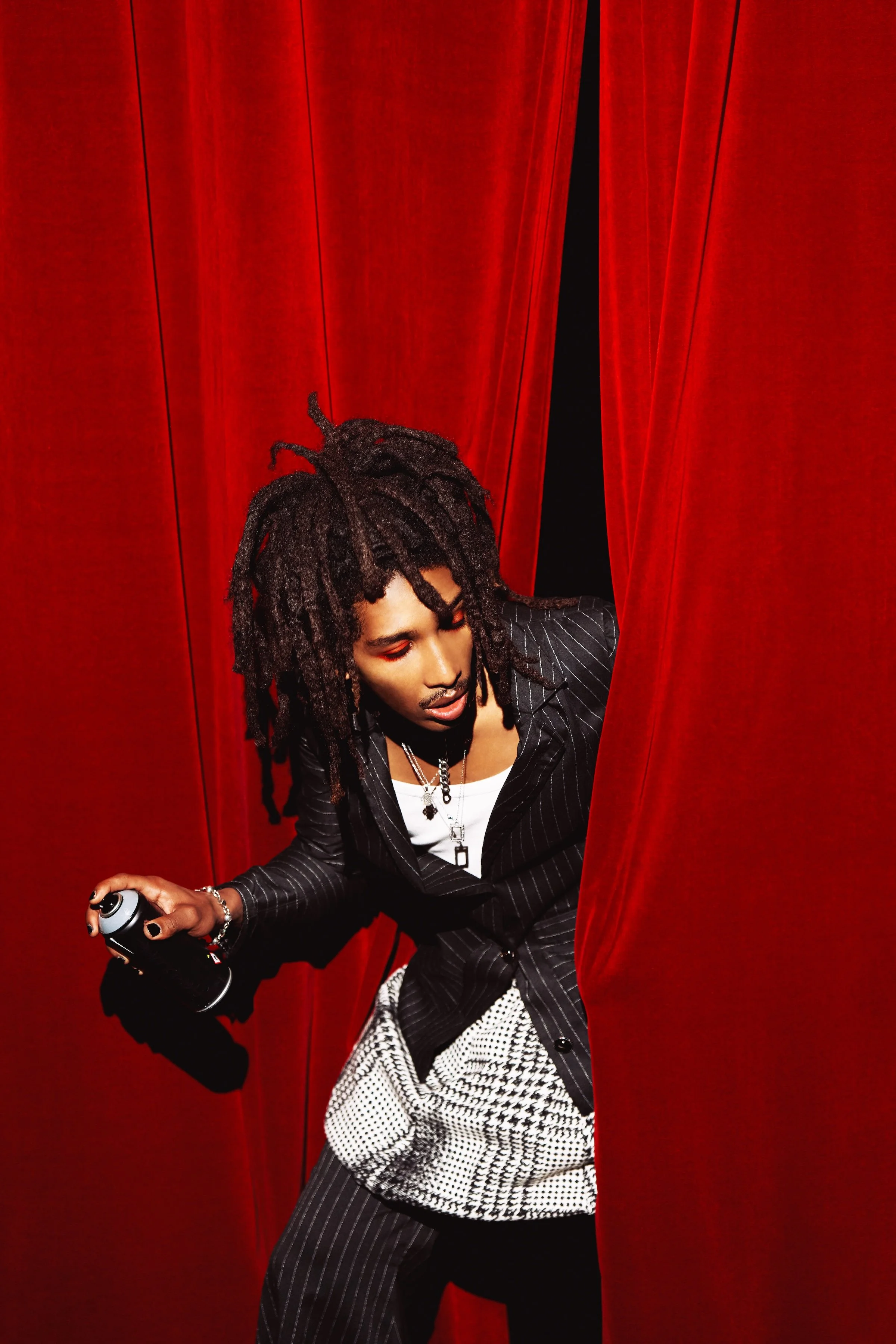
Suit: Ganni, Skirt: Solène Lescouet, Jewelry: Red’s Own
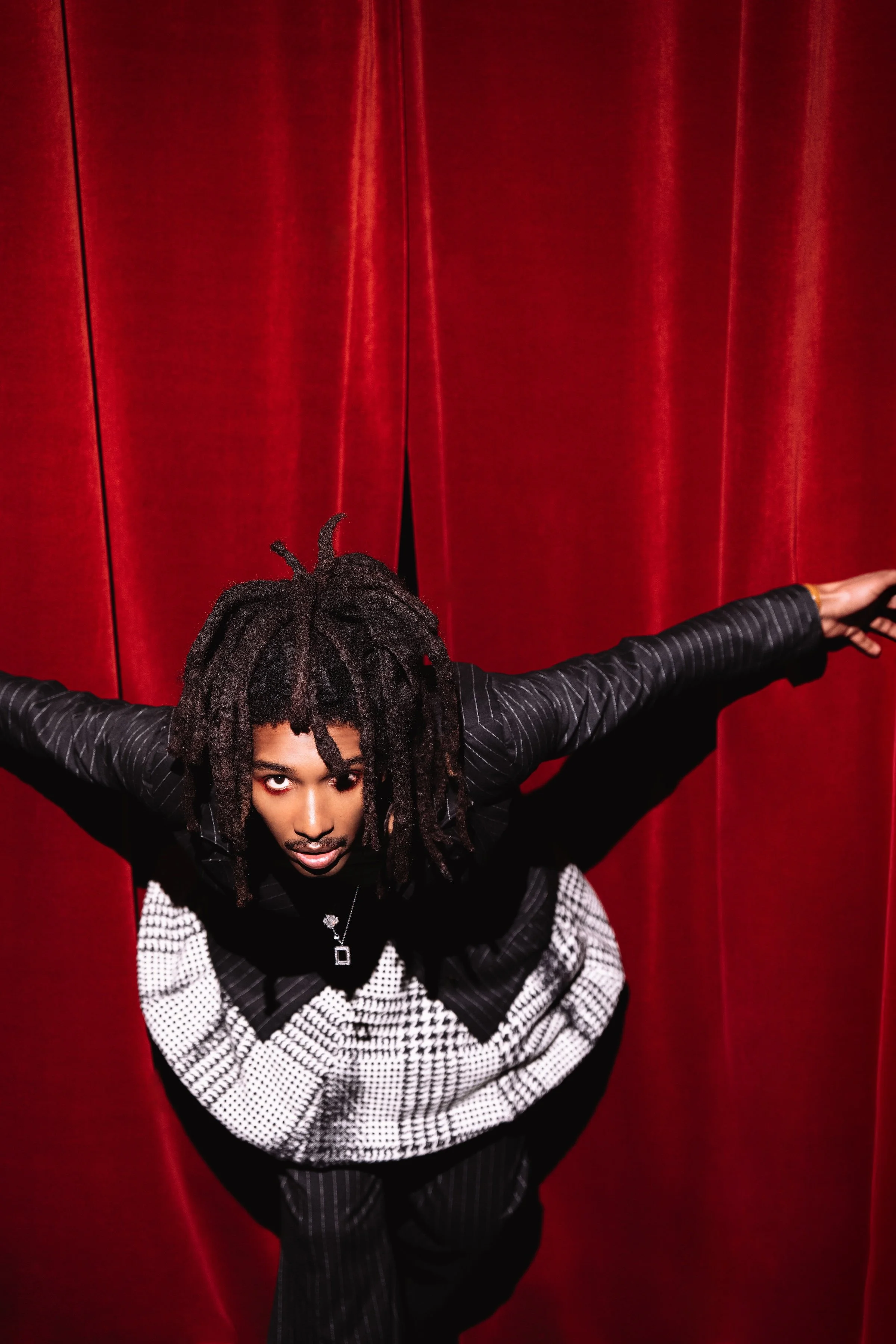
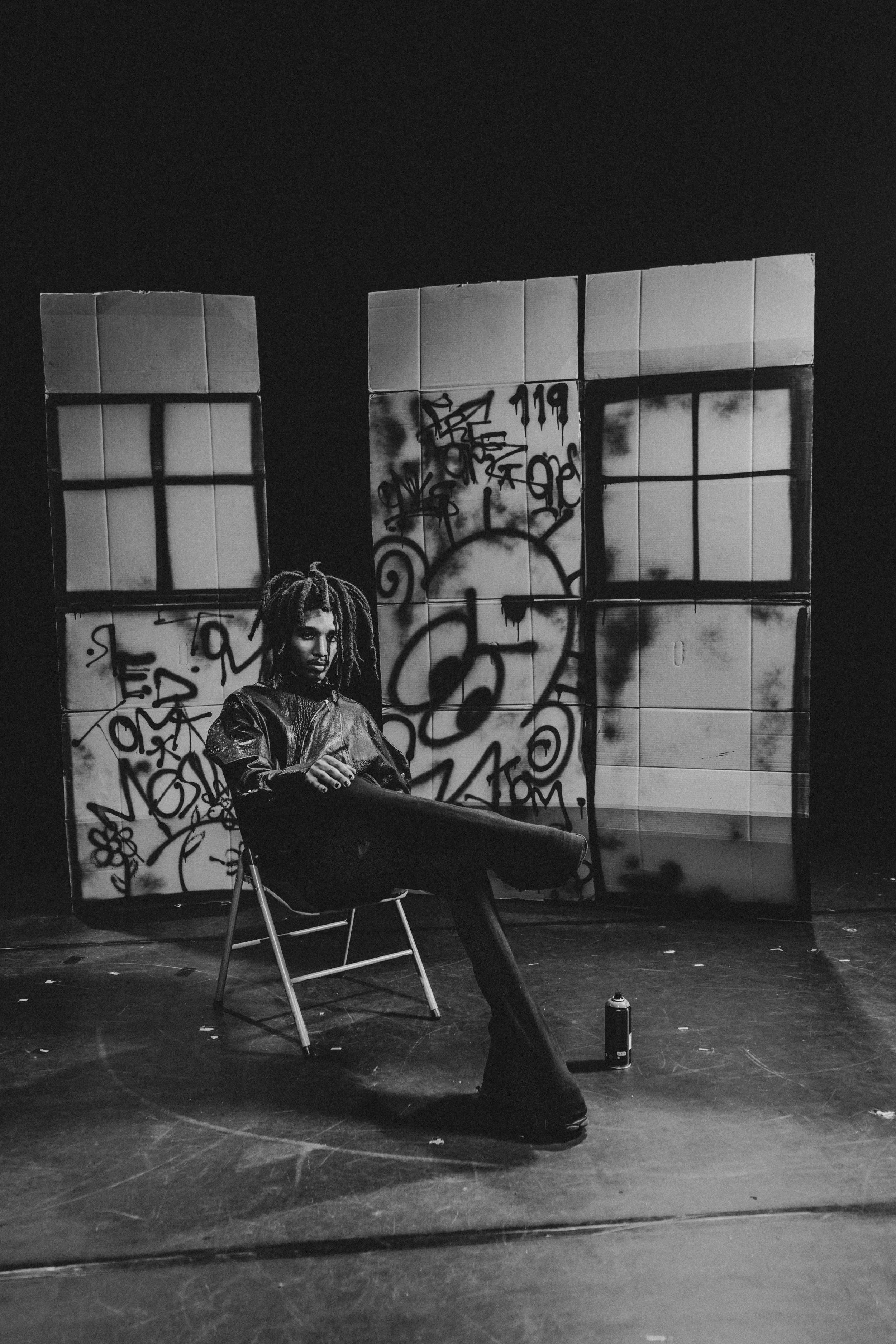
Top: Maison Jaeghere, Pants: Rick Owens
Graffiti became my salvation. They were a way to shout without speaking, to free myself, to exist in a space that didn’t require explanations. There I could be whoever I wanted, without skin color or my history mattering. Just a message, a sign, something to leave behind for others.
After several legal troubles because of graffiti, I decided to move to Paris. One day at a bar near the Centre Pompidou, I drew on a napkin. A face, a stylized logo: it was a child scared but also full of wonder at life. It was the first time I truly felt I had a voice—even if no one was listening. Since then, I never stopped.
MERDE: Your work feels like it’s constantly resisting categorization: graffiti, design, protest, joke, warning. Do you feel like you’re building a language, or breaking one apart?
RED LONGO: Maybe both. I’m building a language with the pieces I find, but whenever I define it too much, I feel like destroying it. Labels are for others, not for me. I want my work to be a reaction, visceral, not rationalized.
MERDE: There’s a kind of controlled chaos in your process. What does a typical day look like when you’re working on something? Or is every piece different?
RED LONGO: There’s no typical day. I can spend hours staring at a wall, then snap and throw everything down in twenty minutes. Or I work on it for weeks. The only constant is the body. I trust my gut more than my head.
MERDE: You’ve said before that you “don’t do softness.” Is that still true? Has your relationship to vulnerability changed as your platform grows?
RED LONGO: I don’t do sweetness, but vulnerability, yes — they’re different things. Over time, I learned that even anger is a form of vulnerability; it just screams instead of crying. Having more visibility hasn’t made me softer, but it forced me to be more honest. It’s a risk, but the only way to stay real.
MERDE: Censorship can be overt or insidious. Have you felt your work—or voice—muted in any way by burnout, by institutions, by expectation?
RED LONGO: Absolutely. Sometimes the system silences you; other times you self-censor without realizing it. Burnout is the sneakiest enemy. But every time I feel muted, I remember why I started. I don’t work to please—I work to disturb.
MERDE: You’ve spoken about the pressure to be ‘palatable’—for the algorithm, for brands, for curators. How do you protect the rawness in your work from being diluted by exposure?
RED LONGO: I don’t protect it. I risk it every time. If I start thinking about what works for the algorithm, I stop being an artist and become a product. It’s a constant battle. The solution? Go back to the streets. There, no one gives you likes, but you immediately know if what you’re doing makes sense.
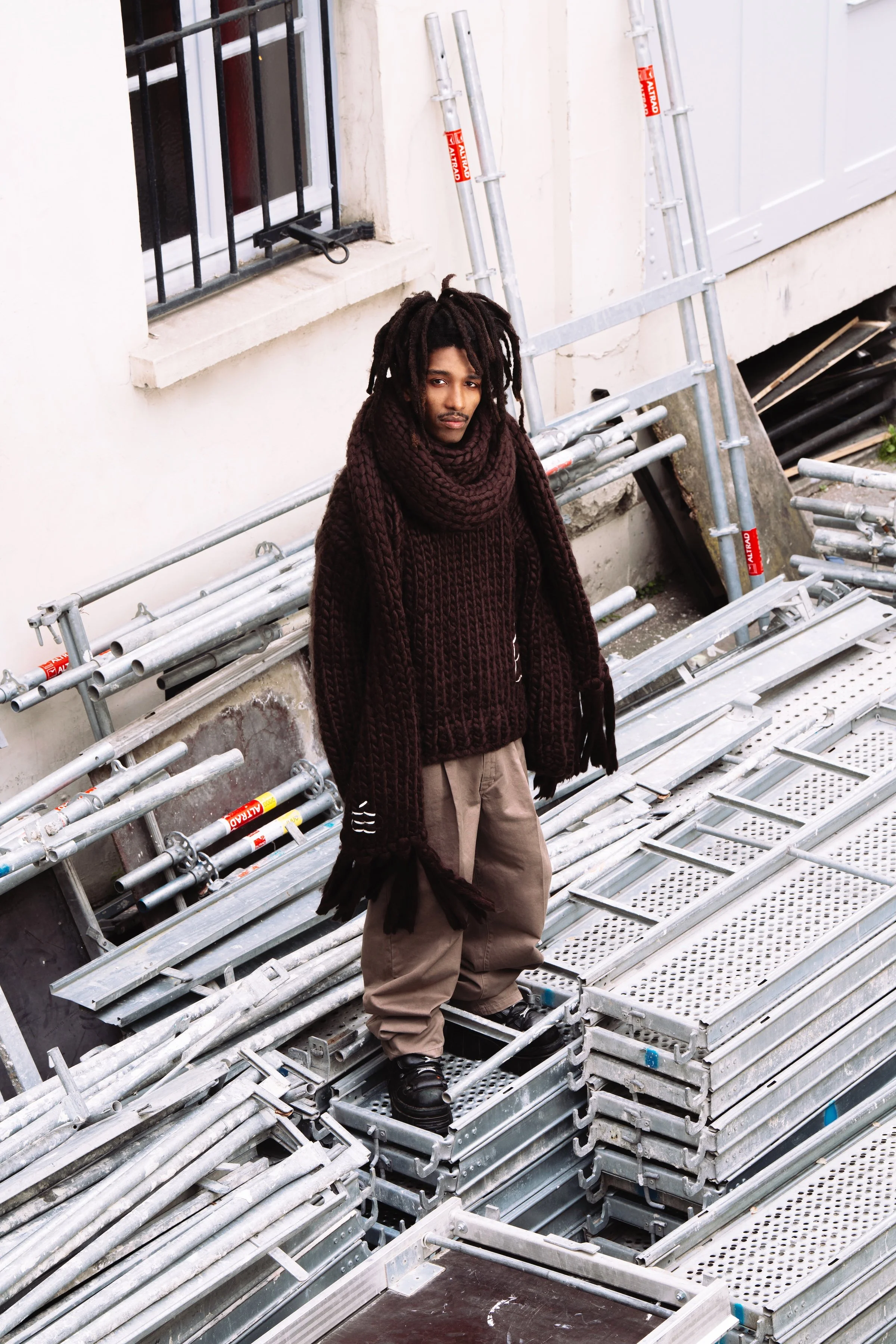
Total Look: Études
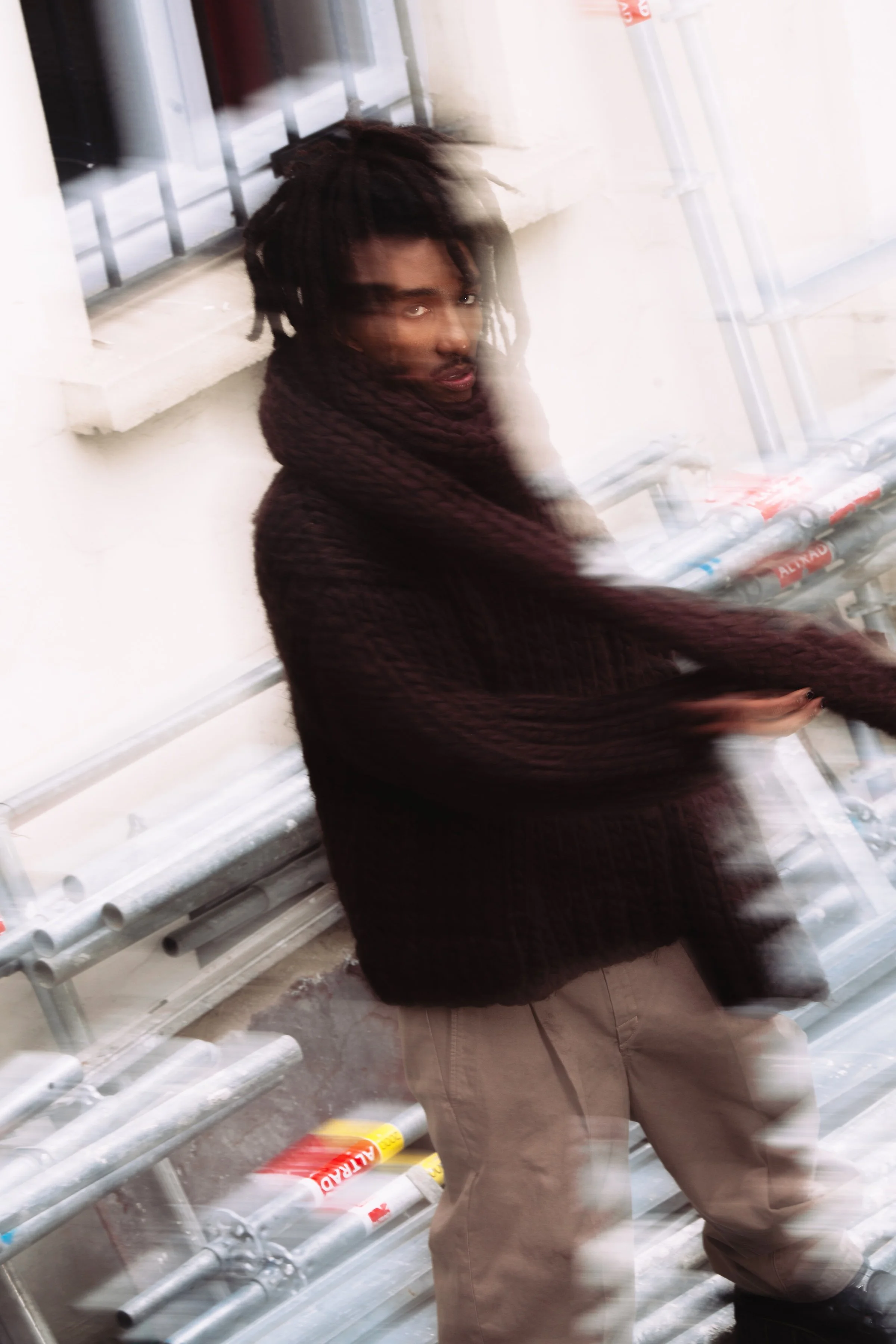
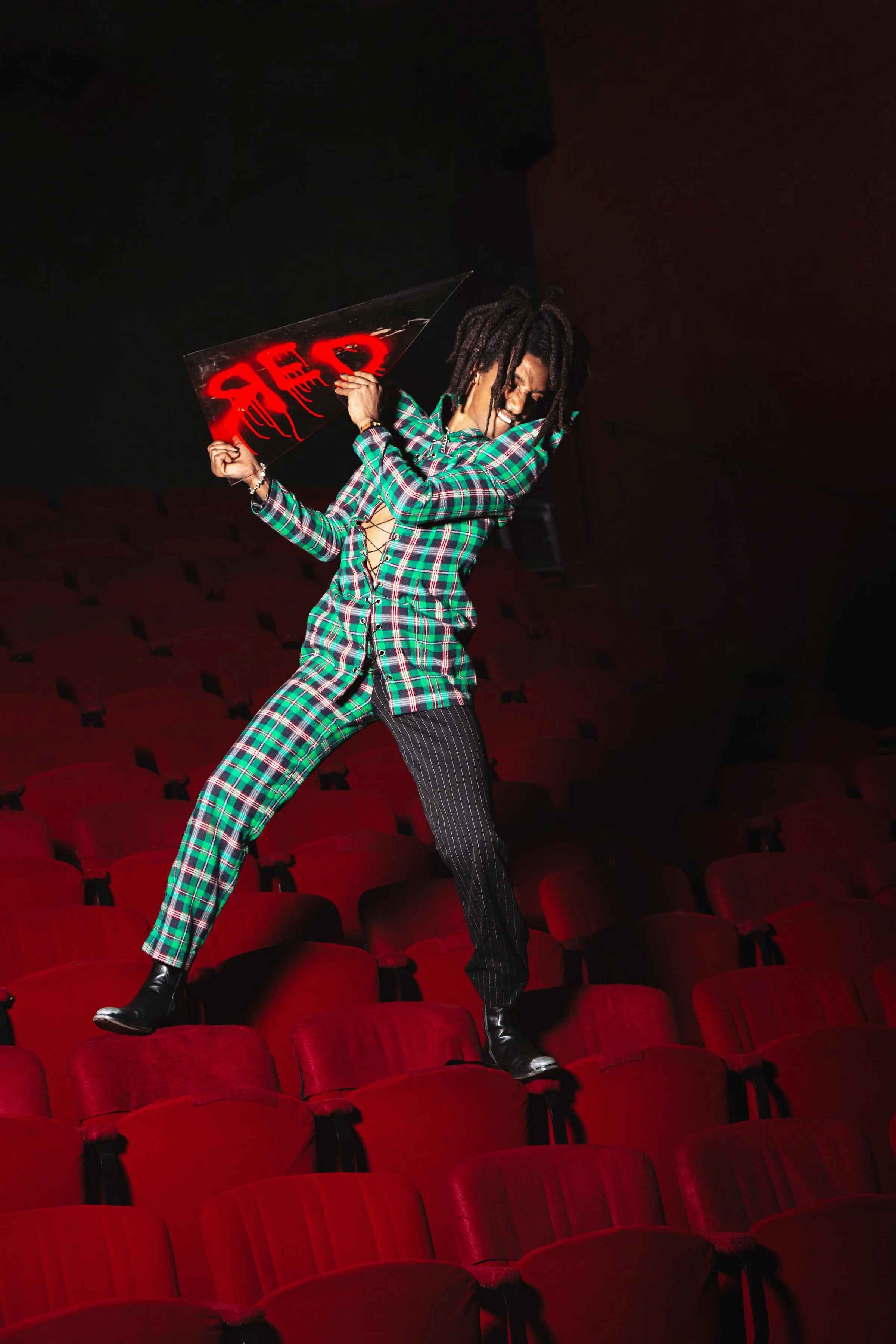
Total Look: Solène Lescouet
MERDE: A lot of artists talk about ambition like it’s a linear path: step one, step two, payoff. What’s your version of that story, if any?
RED LONGO: My ambition is a circle, not a line. I always return to the same point, but every time with more awareness. I never believed in “making a career.” I just want my work to outlive me, to say something even when I’m gone.
MERDE: Where do you locate the edge between creation and consumption? Has that line shifted as your following grows?
RED LONGO: The line moves, but I try to keep it clear. I create when I’m in the flow. I consume when I’m seeking approval. When I start counting views, I know I’m in the red zone. Then I shut everything off, take a train, and go paint somewhere no one knows me.
MERDE: What does ambition mean to you now? And who gets to define whether it’s paying off?
RED LONGO: Ambition today means freedom to me. The freedom to say no, to change path. No one outside measures it. True success is being able to keep doing what I love without asking anyone’s permission.
MERDE: When do you feel most like an artist? When you’re making? When someone reacts?
RED LONGO: When my hands get dirty. When I feel out of place but at the same time exactly right. And yes, even when someone reacts badly, gets angry, or stops to stare too long. Then I know I touched something real.
MERDE: Has visibility made things easier—or just more surreal? Where do you see this bridge between fashion and graffiti taking you next?
RED LONGO: Visibility hasn’t made things easier; it made them more surreal. Suddenly, what was a personal act becomes public, and the stakes seem higher. But that tension feeds me. The bridge between fashion and graffiti feels natural to me. Both speak about identity, rebellion, and communication in public spaces. I see this connection growing, pushing me to challenge conventions, mix codes, and break boundaries. The next step: I want to blur the lines even more, creating work not just worn or seen, but lived, immersive, raw, alive.
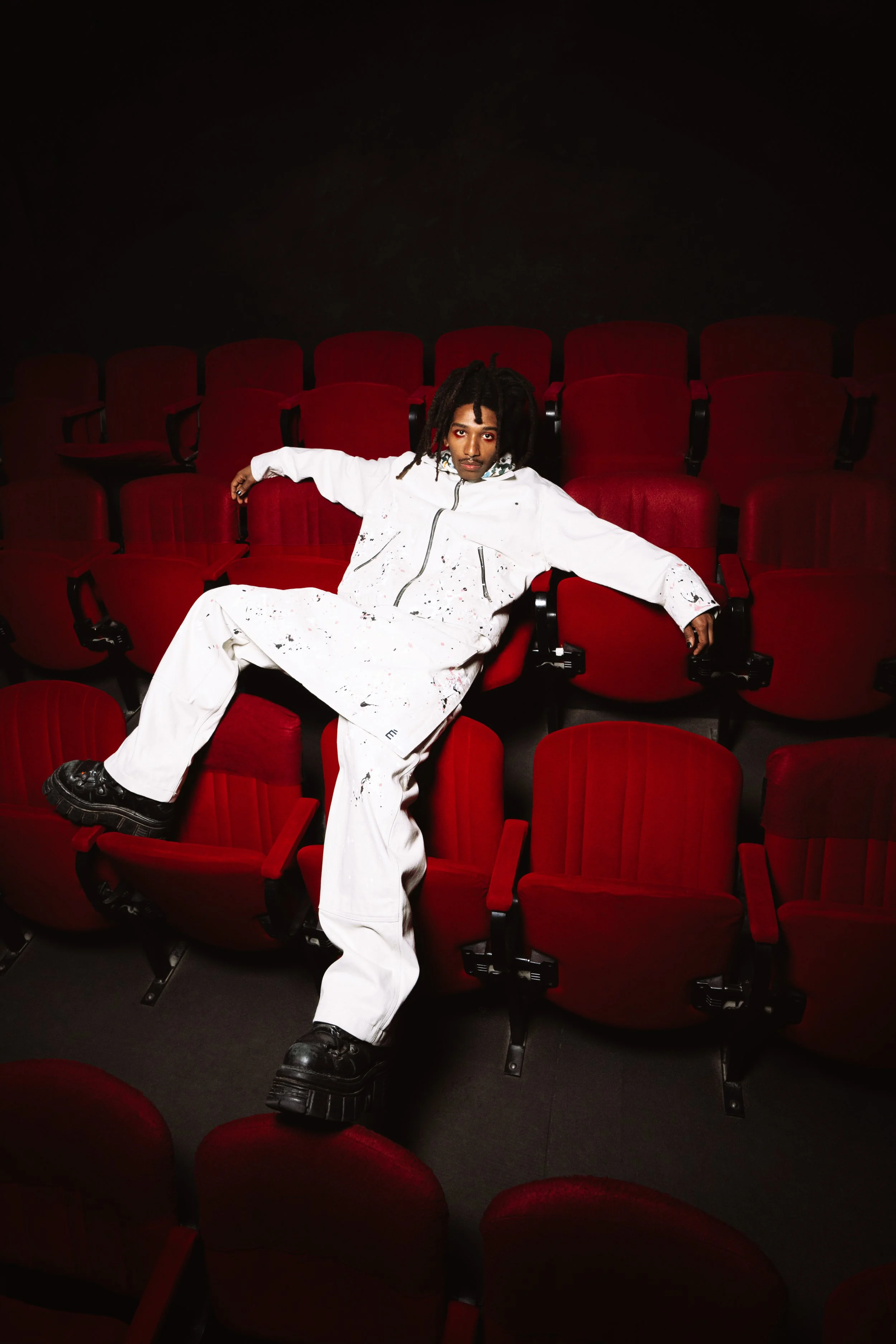
Total Look: Études
MERDE: You move between creation and collaboration constantly—painting walls one day, designing clothes the next. Where do you draw the line between what you make for you and what gets made for others?
RED LONGO: The line is never fixed. It changes with the project, the energy, the people involved. When I create for myself, it’s pure, instinctive, sometimes chaotic. When I collaborate, there’s a dialogue, a negotiation, but I never lose my voice. I try to keep the rawness, the urgency. If I feel like I’m creating just to please others or fit into a scheme, I stop. Authenticity has to remain the base, whether the canvas is a wall or a jacket.
MERDE: Fashion and graffiti are both about claiming space: visually, culturally, politically. Who in fashion do you feel is speaking the same language as you? And who lit the fuse for your own style?
RED LONGO:I respect anyone who uses fashion as a tool for resistance and identity, not just decoration. People like Virgil Abloh spoke a language I relate to. They challenged the status quo and mixed worlds in ways that inspired me. The fuse for my style lit slowly from my upbringing, my roots, and the streets. The rawness of graffiti mixed with the codes of fashion became my voice.
MERDE: How did your background and the places you grew up in influence what you paint now? Do you still carry those environments with you when you create?
RED LONGO: Absolutely. My background is in my work like a shadow. I carry those streets, those struggles, those memories everywhere I go. They remind me who I am and why I create. They keep me grounded even when my audience grows.
MERDE: Is Red actually your favorite color? How does your name reflect who you are or the message you want to leave behind?
RED LONGO: If Red is a color of passion, anger, love, and danger. It fits me because I want to provoke and move people. I want my name to be a signal, a call to attention. Something that stays with you like a burn or a heartbeat.