
Her Own Frame: Diane Pernet’s Shaded View on Fashion, Film, and Truth
Words by Molly Apple
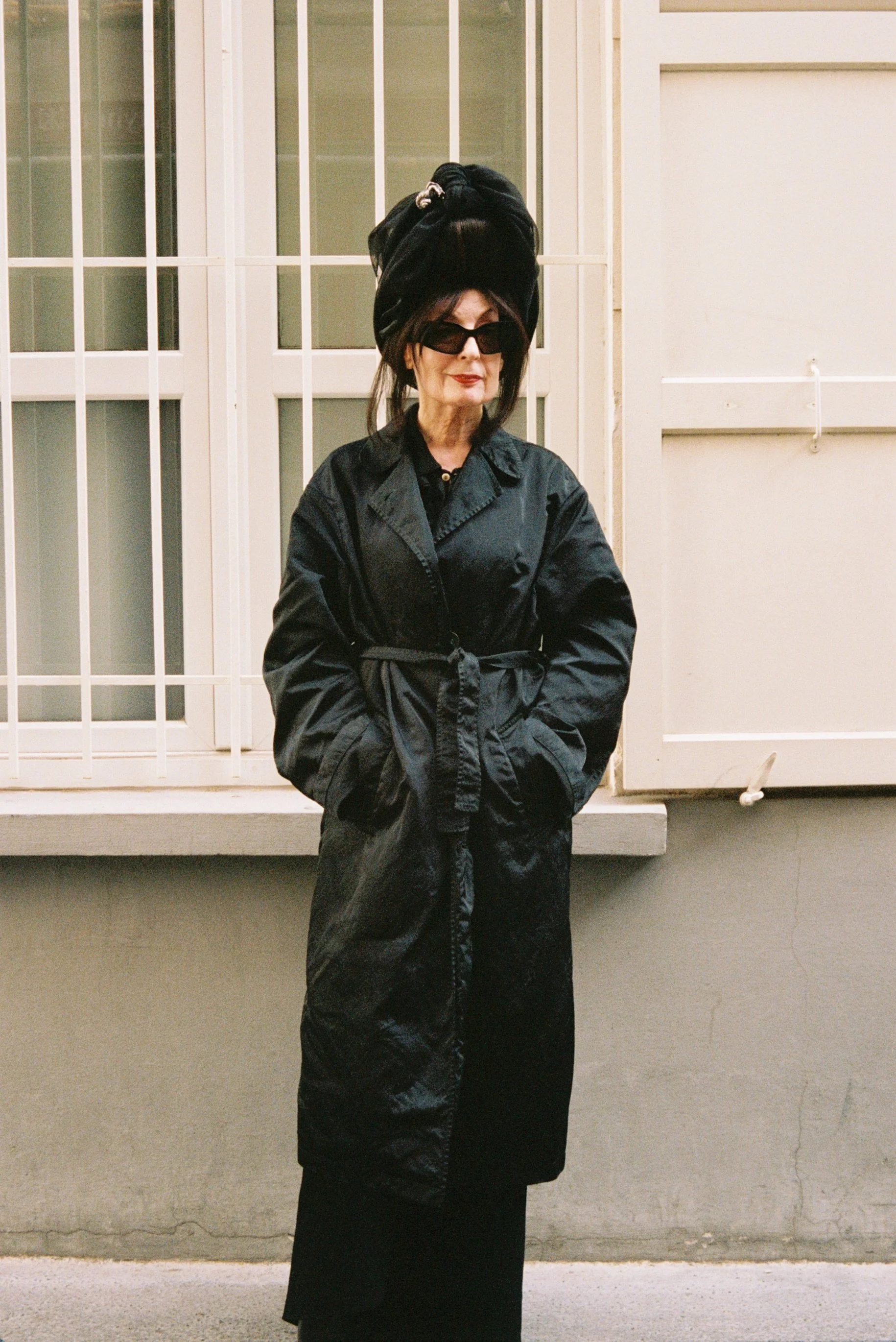
On a bright Sunday afternoon at Café de Mars, just near the Tour Eiffel, I sat down for a chat with American-born, Paris-based fashion icon and founder of ASVOFF (A Shaded View on Fashion Film Festival), Diane Pernet. I was visibly nervous to meet the woman I’d admired, from her glamorous tented headscarf that’s always caught my eye at fashion events from London to Paris — and now here she was, sitting across from me on a perfect spring day, with a cup of tea in her go-to neighborhood café.
I’d come hoping to unravel the layered meaning behind A Shaded View on Fashion from the woman who shaped it into an institution. What I didn’t expect was that our conversation would cast an even brighter light on Pernet’s resilience and artistry.
Her all-black gothic aesthetic, encyclopedic knowledge, and connectivity might feel intimidating at first, but Pernet’s warmth and thoughtful answers to my long-winded questions quickly set the tone for a discussion about the power of individual expression, with the occasional outburst or sharp bark at a past partnership gone wrong. I was acutely aware that the café staff, and even the resident cat weaving between our chairs, seemed just as delighted by our yapping. A young child toddled past us, and Diane cooed at the baby’s little shoes, letting me into her softer, more maternal side. Behind the formidable front of the ‘mother’ of Fashion Film is an inner warmth.
Pernet’s advice for aspiring filmmakers is to “be authentic and don’t follow trends.” She’s surprisingly open to the integration of AI at her festival, especially for its potential to push set design in new directions. For Pernet, co-curating a fashion film festival today means holding onto core values while staying open to new technologies — a shaded view, indeed.
Diane sees co-curation as essential to keeping ASVOFF alive and relevant. While she has ultimate authority, she purposely steps back to let her jury bring fresh voices and different perspectives. “If you’re a senior curator, you were selected because you should be an authority in your field,” she explained. Her trust in new curators is balanced with incredibly high standards, “I like strong opinions,” she says, “a variety of people, backgrounds, and ages.” I see ASVOFF as an unrushed force in comparison of seasonal fashion weeks for both men’s and women’s calendars — spectacles that so often lose their intentionality as they’re rushed through the algorithm of social media. We’re all rushed to know the next best designer or next best collection, we often forget to honor the original greats.
“I don’t know if you know who Marc Ascoli is, but he gave Nick Knight his first job– for Yohji Yamamoto,” a juror this year, “and most younger people don’t know who he is, which is criminal.” She notes, “then again, most people don’t know who Claude Montana is either.”
The festival sits in its own shaded bubble of singularity. There are new additions to the jury each year, real time spent reviewing submissions, and an attention to the process that reminds me of how we approach MERDE’s annual print issue — ready to disrupt, but will take time to do it. “We have Matieres Fecale, in their early twenties, who was a juror last year and is back this year, Ly.as, Pascal K Douglas, who is a really great writer, Manish Arora, who is a costume designer.” When asked about bringing back Willy Chavarria as this year’s festival president, Pernet says, “Willy is brilliant, and his film won the grand prize. I didn’t actually meet him until after his powerful show last January; I thought it was the best show of the season. He has beautiful and warm energy.” More than an excellent designer, he’s a storyteller, “he’s proud of his culture, has a depth, and is perfectly in sync with ASVOFF.
This year’s 17th edition festival has themed categories: Black Spectrum, Mental Health in Fashion, AI Generated Films, Chinese Films, Climate Warriors for kids and teens, Queer Archive, Student Films, and Fashion Intelligence. Pernet is especially proud of the category Climate Warriors for kids and teens, “and how they see the future of the planet.” She says, “ASVOFF is not a cliche fashion, it’s a cultural event. It’s about themes that are extremely relevant in the time we’re living in.” The second edition of the category Mental Health in Fashion is more important than ever, “that theme was packed [with submissions], that says something, doesn’t it?”
We have more in common than I’d imagine: Diane was candid about the fact that nearly all of her worst professional experiences have involved men — “All of my bad experiences are with men,” she told me, recalling collaborators who looked great on paper but proved unreliable or domineering. She admits she’s still learning not to give people endless second chances: “Every time I kick myself for doing it again…I’m still trying to work on it.” Her guarded yet gracious approach today comes from hard-won lessons about protecting her vision. There still aren’t many female creative directors, and Diane’s feelings about working with certain men really hit home for a lot of us — myself included.
For MERDE’s submission to ASVOFF, another acronym titled “OOO - Out of Office,” I worked with a male director and cinematographer, and I shared with Pernet that it was, by far, the most cohesive and collaborative experience I’ve had with a man in a creative role.
Our creative process felt intuitive and thoughtful, as we navigated narrative control without a fixed destination, allowing the story to unfold naturally through the shoot and editing. OOO captures an overarching unease and instability thematically, that I feel aligns with the experimentative nature of ASVOFF, which explores film beyond traditional formats.
Pernet was a fashion designer before broadening her creative medium into film, “I’ve never been into trends ever, I’d rather carve my own path, as I’ve done with everything.” Her first collection was inspired by the Bauhaus, “I have a thing about form following function, I don’t like things that have no reason to exist.” She says, “To me, to make a pure line, a pure design, takes a lot more than to decorate it.” She used to freelance, like the rest of us! “I was doing some freelance work alongside the designer Anna Sui for a sportswear brand, which was never really my thing, but was a way for me to make more money to put into my own brand.” Aesthetic opposites, Pernet notes, “the whole concept was the more you decorate, the better it is.”She’s even more truthful when she admits “the problem with mine [line], it was too highly designed for the price point it had to be. Even if it could fit in a certain price point, the design level didn’t work in that department, it belonged in the next category.” She laughs, “They hired Anna Sui back, and not me. We had totally different ways of designing.” The two women went to India together, and Diane remembers “Anna went into every store, but me, I’m not a shopper. I wore my own clothes at the time.” Bringing it back to the present, she told me, “When I go to the designers’ shows and showrooms I like, I’m not shopping — I’m admiring.” That separation between consumption and creation is a distance many creatives know well. It’s a bit like actors who never watch their own films: the work exists to be made, not necessarily to be owned.
In the late 80s, before moving to Paris, Pernet worked on a collaborative lingerie collection featured in the New York Times. “It was like jumping off a bridge, whatever happens, happens, I just didn’t want to be in New York anymore. It was too depressing, everyone dying, human feces, merde on your doorstep.” She moved to Paris in 1990 with a costume design job for a film project, and it wasn’t necessarily easy entering the costume space from fashion design, “he was afraid of me because I was a fashion designer. When you’re a costume designer, you’re building a character, maybe a tiny necklace with a heart on it makes the whole outfit because it’s part of the character’s DNA. It’s not always obvious styling.” This was the seed planted for her film festival. “Things move very slowly in Paris,” says, continuing, “something good always comes from something bad,” she says, “there’s no bad experience if you learn something and it takes you somewhere else. It shouldn’t crush you.” After costuming, she became an assistant producer for CBC’s Fashion Files. “I’d known Tim Blanks for decades, and he was the on-camera person at Fashion Files.” “It was insane, I was guarding tripods at fashion shows so the cameramen had a place in the pit,” she notes– this was before fashion show invites were emailed, and sent snail mail. “We used to call it The Army of The Unwashed,” Pernet laughs, which is a stark contrast from fashion-show-goers today who are shuttled to entrances in black car Ubers and mainstream media who have placards in the pit. “I would run into the camera guys that used to cover my shows, and they all thought I was the on camera person, but I was guarding the cameras.” It's this humility that makes Diane Pernet a fixture of an industry that so often only promotes the glitz and glam, and not the real grit it takes to stay, adapt, and continue the grind. “It was maybe three months of work a year, but whatever, it was something” she says, echoing every freelancer that ever was.
In one of many offshoots from our conversation, Diane told me about Roxanne Lowitt — one of the first backstage photographers, adored by Lagerfeld, Saint Laurent, and famously close to John Galliano. “She told me that she published her book, Dior: John Galliano Years, and after the scandal, they burned every copy. She was grey as ash when she told me.” That kind of forced erasure — a tidy rewriting of fashion’s darker histories — is exactly what ASVOFF refuses to do. Instead, it creates space for stories with clear conscience to exist in their full truth: the beautiful and the messy. Scandal permeates our world, and I was curious to hear Pernet’s take on the recent dramas because she comprehends both the intentions and ramifications as a fellow creative leader. “When I saw the doll, the bag, in Demna’s showroom, I didn’t think anything of it. You could say it was bad judgement, but to accuse him of all these things that were absolutely not true, was disgusting.” We agreed not all the blame should have been on Demna, there’s a whole team of people that ideas and products run through before hitting the shelves, or in the case of film, the screen. It’s only natural to look to industry veterans for their insight on such contentious matters, so it was no surprise to me that Diane relayed she was also an advice columnist in the late 90s for Elle Magazine called Doctor Diane. “It was a styling column, and it covered events and fashion shows, but you could only cover the advertisers.”This struck a chord with me, as MERDE’s core ethos was born on the promise to feature designers and artists that are atypical or ‘problematic’ to mainstream media. “I got one designer a season that I could stick in there,” she notes, which sounds incredibly monotone, but I’m sure Pernet incorporated her own personal twist. Her editorial stint continued at Vogue.fr, where she worked under Tina Isaac, who brought the magazine online. Pernet started her own blog in February 2005, “because I wanted to cover, like you, MERDE, the people I wanted to cover without any advertisers.” A Shaded View on Fashion, the blog that still exists, is “20 years old now, it could use a facelift,” Pernet says.
Change is inevitable, and while Pernet is certainly keeping up with the times, attending emerging designer shows at global fashion weeks, and inviting disruptors to judge the film festival, she says that sometimes a change without purpose is silly. “When Hedi Slimane comes in and makes some tiny change on the logo and it costs millions, for what?” Fashion is no stranger to a changing of the guards, and the seasonal reshuffling of Creative Directors often feels purposeless, like there’s a fashion puppet from above, pulling the wool over everyone’s eyes with no other reason than to stir the pot. “If you’re going to put John Galliano anywhere, put him back in his own collection,”’ Pernet attests.
Her career was full of fashion, costume, cameras, and editorials, but not without crooks and chaos. Pernet faced ownership and licensing issues with a previous business, “he trademarked my name.”Despite it all, her resilience shines through, “I never say a Jaded view, only a Shaded View on Fashion,” she notes, her vision always protected behind her dark glasses. “Always trust your instinct,” Pernet warns.
It was announced that Anna Wintour will step down while writing this article, and while I know the role will dissolve and Diane most likely doesn’t subscribe to Vogue US, I just had to know who she’d select as a leading figure of the publication. I’ll trust my own instincts in the belief that Pernet and ASVOF will undoubtedly continue to rebel against the power structures that dominate creative industries, dismantling the hierarchy that polices taste, gatekeeps experimentation, and sanitizes our spirit that fashion needs to survive.
The 17th edition of ASVOF takes place November 13–16 at Dover Street Market Paris, proof that Diane’s vision for fashion film—and its refusal to bow to convention—remains as necessary as ever.